

How To Draw A Level Line On A Wall
How to Utilise a Chalk Line to Mark a Straight and level Line on a Wall, Flooring or Other Surface to use every bit a Guide
In this DIY how-to guide yous will learn all most the chalk line. We volition show you how to correctly fill the chalk box with chalk, coat the line in chalk and so use the chalk level itself to marker a clear and divers line on to a wall, floor or other surface so that you tin can use it equally a guide when fixing timbers, tiling floors and walls, wallpapering and many other jobs.
When fixing timbers effectually the peak of a wall or other surface to grade a ceiling or other construction, it is essential that they are all straight and level; this is no like shooting fish in a barrel chore.
If y'all aren't lucky plenty to have a light amplification by stimulated emission of radiation level (find out more nigh laser levels hither) and then 1 method is to measure up from the floor and mark at regular intervals at the required height and and so join all the marks up with pen using a straight border such as a spirit level.
This may seem like a good solution, however information technology isn't ideal as there is plenty of margin for error.
In the building trade in that location is a tool for every possible job and this scenario is no exception.
The weapon of selection in this scenario is the chalk line and to these ends, in this DIY guide you volition learn how to use a chalk line to mark a level horizontal line on a surface.
What is a Chalk Line?
When it comes to the question of what is a chalk line, the answer is actually in the proper noun; information technology's a line covered in chalk!
On a basic level, this is exactly what it is simply every bit with most things, at that place's a picayune more to information technology than just a slice of string with some chalk on information technology.
The chalk line tools itself is a highly versatile tool and tin can be used to marker a perfectly straight line on pretty much all surfaces for pretty much any job that needs a straight line to follow e.thousand. laying both flooring and wall tiles, roofing piece of work, wallpapering and more.
The main torso of the tool or "chalk box" is essentially a container for the chalk. Inside the master body, along with the chalk, is a shaft and the line is wound around this via the handle on the outside.
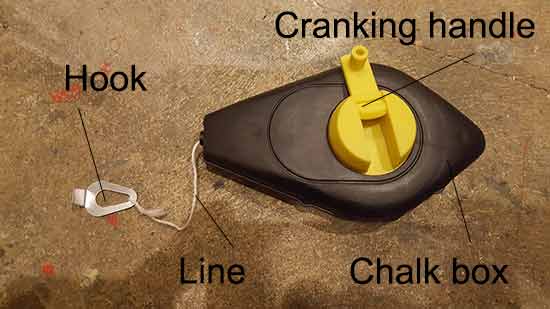
The chalk line in all its glory
When the string or "line" is wound back into the body, it sits in the chalk assuasive the chalk to fully cover it so that when information technology is pulled out, it has a suitable amount on it to allow a articulate line to be defined on the surface you lot're working with.
Tied to the stop of the line is a claw (or claw as information technology's also sometimes known). This has two jobs; firstly to permit you to hook it on to a fixed object so that you tin create your line and secondly to forbid the line from disappearing inside the chalk box.
One question you may be asking yourself is: if I'm marking a line, should I utilize a chalk line or a light amplification by stimulated emission of radiation level? This is a valid question indeed and in reply, it really depends, they both have their pros and cons.
If you are lucky enough to already accept a laser level, then cracking, certainly make use of it!
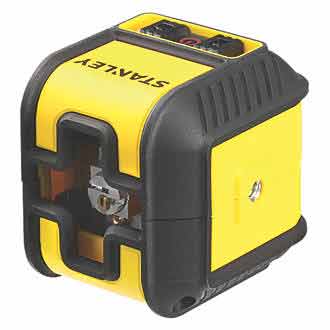
Stanley Cube laser level
On the other hand, if y'all don't then certainly do not rush out and buy one. They are expensive pieces of kit (ranging from £50 up to well-nigh £chiliad!) and if you lot only need to mark a few lines now and then, it will exist a massive waste of your coin.
If yous have neither tool then you should certainly become out and merely a chalk line. For the cost of effectually £5 you can go yourself a chalk line kit that should contain the line itself and enough chalk to cover all of your marking needs for a proficient long while.
To summarize the above, when used correctly a chalk line will produce a clean, well-baked line that'southward every bit every bit good as that produced by a laser level, for a fraction of the toll. So if you demand a general purpose line marker tool at home, a chalk line is your go-to solution!
What Color Chalk Should I apply?
When it comes to the color of chalk y'all should employ this will really depend on what you are doing.
In terms of colours and types available, you have four choices. Hither follows a list of the colours bachelor and what they should be used for:
- Blood-red Chalk: This is the most durable blazon and should be used when working outside or in conditions where your markings are going to be subjected to all types of weather condition or other elements that could easily wash away or quickly degrade them. It is the most hardwearing of the colours

Red chalk line chalk
- Blue Chalk: The full general purpose choice. Blueish chalk can be used on all surfaces and in whatsoever environment
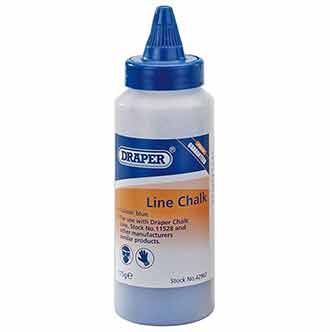
Blue chalk line chalk
- White Chalk: This type should be used for whatever interior work such as painting, tiling or wallpapering. It's like shooting fish in a barrel to remove and should not bleed through whatever pinnacle coat finishes
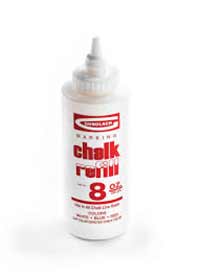
White chalk line chalk
- Fluorescent Chalk: This type is best used in low-lite conditions or on surfaces that may not otherwise show other colour choices clearly plenty to follow easily
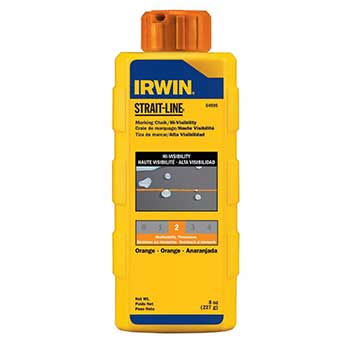
Fluorescent chalk line chalk
How to Fill the Chalk Box
If you have just purchased a chalk line, before you tin actually become started with your marking out, you are going to demand to fill your chalk box with chalk.
If you lot take a new chalk bottle that has non however been used, you lot will probably need to snip the very elevation off of the spout or remove any motion-picture show or cover from the bottle cap.
The canteen nosotros are using has a handy twist cap that opens and closes the nozzle so check this before you chop annihilation off.
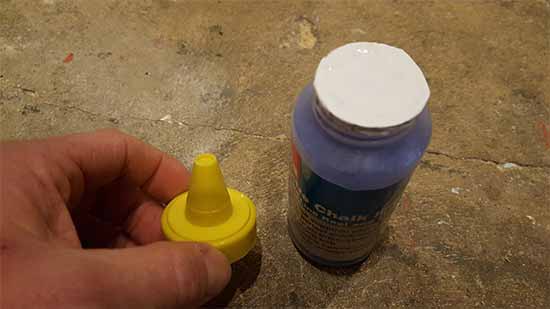
Chalk line chalk bottle with twist open nozzle
Once washed, the next task is to pull out 3 metres or so of the line from the chalk box. Be careful when pulling it out as it can hands get tangled up, causing a right headache getting it all straightened out again.
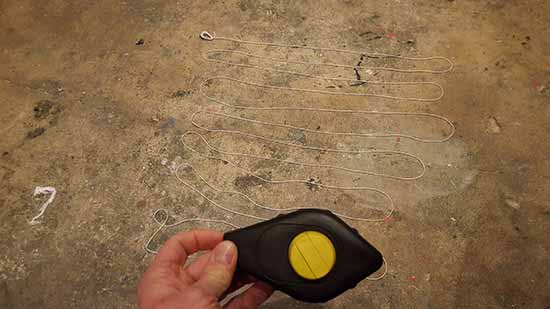
Chalk line pulled out of chalk box set for coating in chalk
With your string now pulled out, on the torso of the chalk box itself there should exist a filling cap somewhere (this can sometimes likewise be a sliding door). Unscrew the cap or slide the door open to expose the inside of the chalk box.
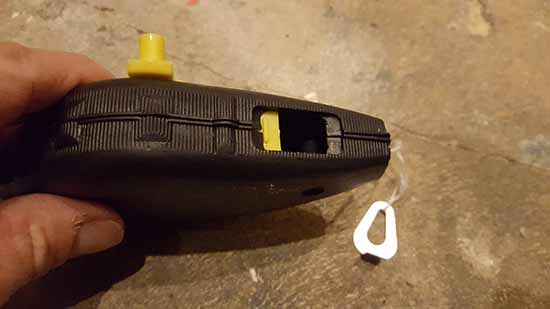
Chalk box filling hole
Insert the spout of the filling bottle into the filling aperture of the chalk box and give the canteen a gentle squeeze to force some chalk in.
Practice this gently as you only desire to fill the box about half way. Additionally, shake the chalk box now and once more to level the chalk that'due south already in in that location and then that you know when to finish.
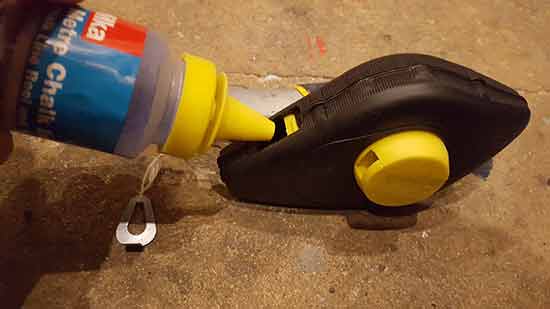
Filling the chalk box with chalk from the bottle
With your chalk at present present in the box, gently air current the string back in, ensuring information technology doesn't become tangled. As the cord is retracted, it will go pulled through the chalk giving information technology a good coating.
It's well worth repeating the in a higher place steps 2 or 3 more than times calculation a little chalk each time (only not too much, you definitely don't desire to fill the chalk box all the way upward!). This volition ensure your line is fully coated and volition produce the best markings possible.
How to employ a Chalk Line to Mark a Straight Line
With your line now fully primed with chalk, it's fourth dimension to become marking!!
Mark Each end of Your Line
The get-go job is to brand ii marks at both the starting signal and finishing point of your line and then that you have two points to run your chalk line between
You can either measure up from the floor or down from the ceiling the option in yours, just before you lot do, make sure which ever surface you're using is level.
For the purposes of this demo we will be measuring upward from the floor. Use a spirit level to cheque this. In this case information technology's level, but if it wasn't you would need to lift the level until it'due south level and then utilise a tape measure to measure out the difference.
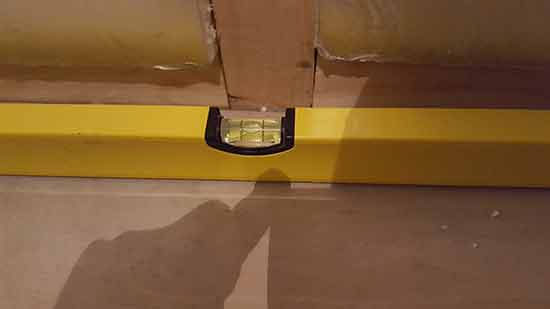
Use a spirit level to cheque the level of the flooring
Once you know how much out of level it is you would and then need to add this amount to the end that is off level to ensure that both marks are indeed level.
Measure up from the flooring at either end and mark each point with a pencil.
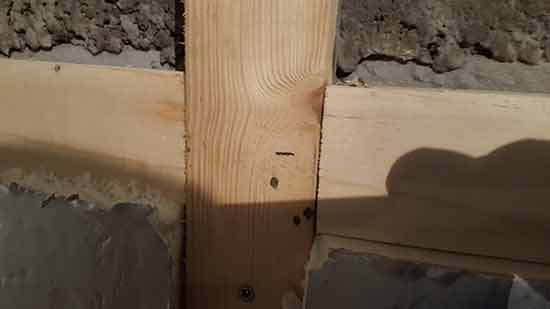
Measure out and marking your starting point
Add a Nail or Screw
To ensure that your line is totally straight, the chalk line itself needs to be pulled tight. To ensure it stays tight yous will demand something to either hold the hook end on your mark, use the claw on the claw itself to pull against or hook the actual hook over something.
In tis example we take knocked in a nail at either finish so that we can hang the claw at one cease and and so at the other, lever against information technology to pull the line tight.
If y'all needed to free both hands upward, using this method y'all tin can wrap the line effectually the end to go along it tight.
Before you secure the chalk line and become it tight, slip ane end over your nail or screw or hold it on your marking and pull it out of the chalk box at an angle away from the surface you're marking and give information technology a slight "twang".
This will get rid of whatever backlog chalk and give you a much sharper line on the surface you're working with.
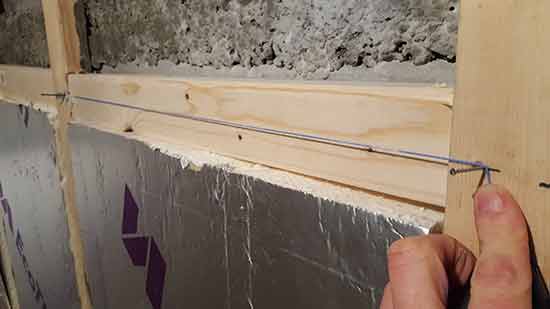
Nails added at the starting time and end marks for ease and to ensure line stays equally tight as possible
Snap Your Line
With your marks made and fixing points ready, slip the hook over your first nail and pull some line out of the box, pull towards your 2nd nail, keeping the line as tight as possible.
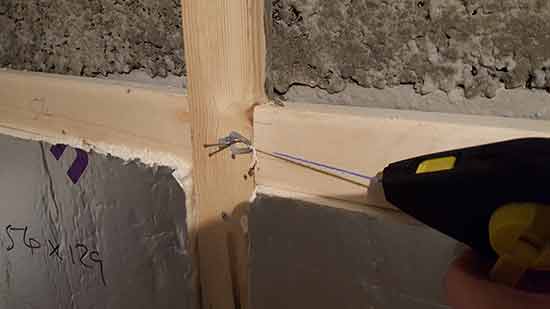
Line hook hooked over boom to proceed the line tight and in identify
As you move towards your second smash, pull the line slightly diagonally to go along it abroad from the area you're marking to avoid getting any excess chalk on the surface.
Secure the line at your second fixing, ensuring it'south as tight every bit possible. Button the line downwardly to the base of each boom or screw then that it's as shut to the surface as possible.
With everything ready, using your thumb and finger, pull the line out around 100mm (4 inches or then) roughly around the centre signal between you're two marks.
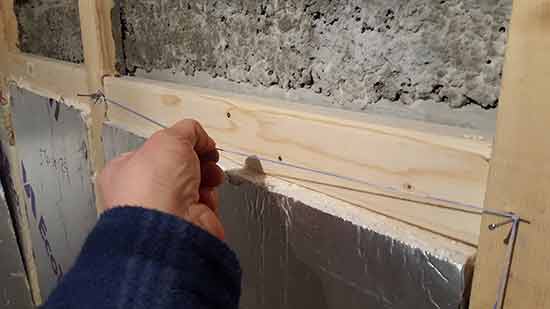
Line pulled out and set for snapping
This volition ensure an fifty-fifty amount of down forcefulness with the snap and ultimately a crisper, cleaner line.
If you lot desire to get your line every bit divers and bold as possible, give it 2 or three snaps.
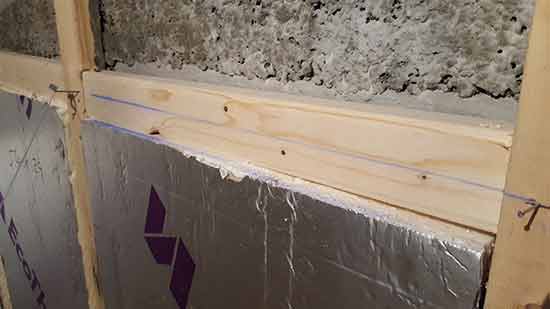
Line snapped and chalk line marked on to surface
If you are creating a line over a long distance, this can be challenging as the longer the run, the tighter the string needs to exist.
A handy play a trick on hither is to get the line as tight as possible (simply non too tight as it may snap) and and so find the rough centre point.
Once you have found this, put your finger over information technology and button down, belongings the centre point tight to the surface.
You lot tin can then individually snap the left and right sides that should and then give a sharper line with much less risk of the line straying away from level.
Cleaning off Chalk Line Marks
Once yous take stock-still your items in place and no longer need your chalk line, ideally, you would desire to remove it.
In reality, this tin can be a scrap catchy, especially if the surface is porous, as pretty much all colours of chalk are semi-permanent, although all apart from the red type tin can be scrubbed off to some degree with h2o and a tooth brush or other stiff brush.
Every bit nosotros have mentioned in a higher place, if y'all do need to ensure any chalk lines can exist gotten rid of as much equally possible, opt for the white chalk.
If yous are working on a non-porous surface you do stand a much better chance of removing the line as the chalk is somewhat prevented from existence pushed down in to the surface, giving you a much better take chances of getting it off.
Maintaining Your Chalk Line
When it comes to any maintenance, the chalk line is a pretty basic tool and doesn't crave much.
The just existent repair that it may require is if the line itself starts to fray, in which case the damaged section can be cut off or if it snaps.
In either situation, all you would so need to practise is to re-attach the hook to the remaining section.
If you are working outside then the chances are that the line will at some betoken, get wet. Every bit I'm sure yous know, h2o and chalk don't mix very well.
If the chalk gets wet it will turn into a paste, rendering it useless.
In this case all you need to practise is pull the line out fully and leave information technology to dry out. Once dry, information technology can and so be wound back in.
If the chalk in the box has become wet so it will need to be removed. Nigh chalk boxes will allow you to separate each side so that you tin access the internals (this is how you can also change the line if needed).
With the box croaky open, clean out all the sometime chalk and dry out it thoroughly. In one case done, you can then put it back together over again and refill information technology.
Using a chalk line to mark a directly line on to a surface is a adequately easy chore and in nearly cases, the more you utilize your chalk line, the more uses you volition detect for it.

Source: https://www.diydoctor.org.uk/projects/Usingachalkline.htm
Posted by: harkinsbectich40.blogspot.com
0 Response to "How To Draw A Level Line On A Wall"
Post a Comment