

Sonnet Egfx Breakaway Box 650w Review
AMD > Nvidia? Whoa —
The external graphics dream is real: Sonnet eGFX Breakaway Box reviewed
Simply even with a Thunderbolt 3 connectedness, there are still trade-offs to be made.
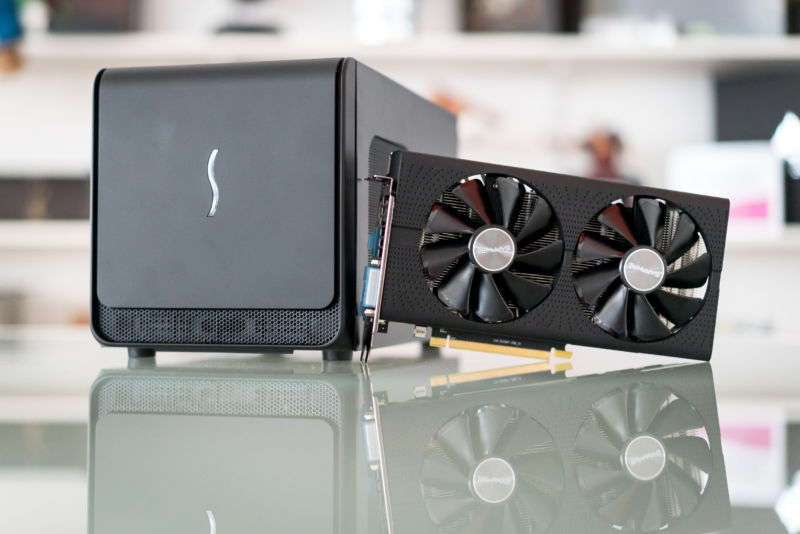
Enlarge / The Sonnet eGFX Breakaway Box and Sapphire RX 580.
Mark Walton
| Specs at a glance: Sonnet eGFX Breakaway Box | |
|---|---|
| Power | 350W Asaka AK-PS035AF01 SFX |
| Ports | 1x PCIe 3.0 X16, 1x Thunderbolt 3.0 |
| Size | eighteen.5cm x 34.0cm x 20.2cm |
| Other perks | 120mm Asaka Fan |
| Price | $300 (~£300, simply TBC) |
The external graphics menu (or eGFX), long the pipe dream of laptop-touting gamers the world over, has finally come of age. Thanks to Thunderbolt three—which offers up to 40Gbps of bandwidth, the equivalent of four PCIe 3.0 lanes—consumers finally have access to enough bandwidth in a universal standard to brand eGFX a feasible option.
So the theory goes, you can at present have nigh laptops with a Thunderbolt three port, plug in a box containing a power supply and your GPU of selection, and enjoy better visuals and higher frame rates in games, and faster rendering in production tasks. You lot can even whack a PCIe video capture menu or a product-gear up audio interface in that external box, if you and then wish.
Thus far the limiting factor, aside from some potential performance bottlenecks and commuter support, has been price. The Razer Core, as beautifully designed as it is, costs a whopping £500/$500 without a graphics card—and that's if information technology'southward even in stock. Meanwhile, the Asus ROG XG Station 2—which is virtually certainly not beautifully designed—costs £400/$400. When paired with a decent graphics card like an Nvidia GTX 1070 or an AMD RX 580, a total eGFX setup runs merely shy of £900/$900, not including the price of a laptop to pair it with.
Fortunately, there's now another pick. Sonnet, a United states-based visitor that makes all manner of Thunderbolt expansion chassis for PC and Mac, has released the eGFX Breakaway Box, a compact Thunderbolt 3 dock for PCIe graphics cards that costs just $300 (UK toll TBC). While admittedly not the nearly attractive of devices (if at least understated compared to the ROG XG Station 2), the eGFX Breakaway Box is perfectly functional, pairing a 350W SFX power supply with i eight-pin (half dozen+2) and one six-pin PCIe ability connector for use with a graphics card TDP of up to 300W.
Theoretically, then, yous can stuff a Titan Xp or Vega Iron within the Breakaway Box and bask l33t-level gaming on a laptop. The reality, however, is more complex. Sonnet'due south Breakaway Box, coupled with some slick commuter support from AMD, hateful that yeah, it is entirely possible to turn a thin-and-low-cal ultrabook into a mean gaming automobile capable of playing games like Doom and Rise of the Tomb Raider at high settings and good frame rates. For those not interested in a separate desktop or a bulkier gaming laptop, an eGFX is a skillful solution.
But there are are limits to what tin be done over Thunderbolt 3, with diminishing returns the more GPU power y'all pipe over the cable. That'south non to mention that, in a world where the likes of a GTX 1050 Ti or GTX 1060 can fit inside a slim laptop, the eGFX isn't quite as alluring as it once was.
Await, why do I want 1 of these?
Still, there are reasons to be excited, not least of which is that the eGFX finally works without the need for complex driver setups (on Windows x at least), and tin can be hot-swapped without crashing your system. This is far cry from the early days of eGFXs when AMD launched the XGH external graphics standard, which substantially took the pins from PCIe slot and passed them through to an external connector (a solution used by Alienware for its proprietary Graphics Amplifier). Other connectivity standards at the time didn't have the bandwidth to support a graphics carte, notwithstanding few laptop manufacturers implemented XGH. Fujitsu Siemens' Graphics Booster is one of the rare commercial examples.
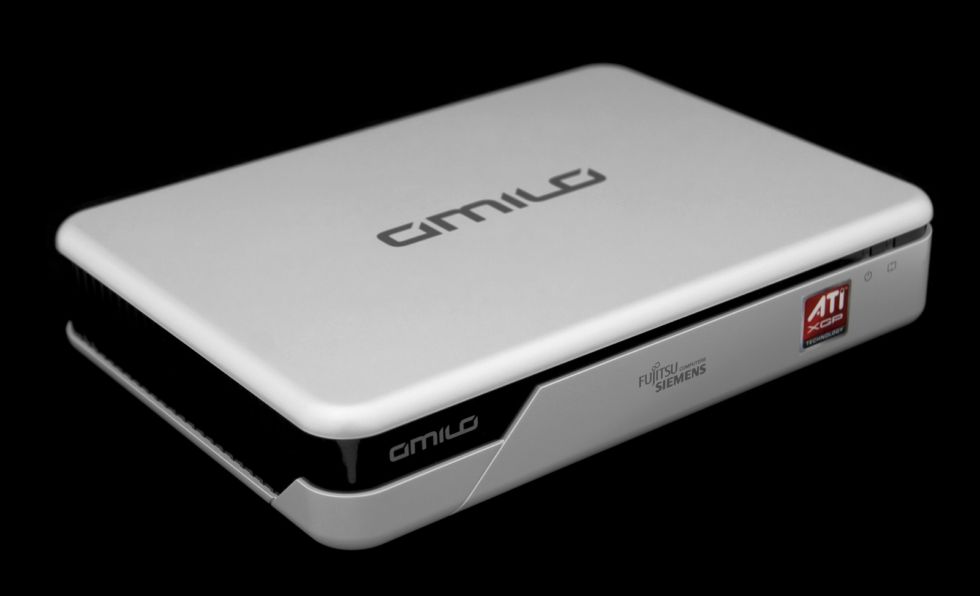
Enlarge / The Fujitsu Graphics Booster was one of the get-go commercially available external graphics cards.
Later, others launched graphics cards linked to ExpressCard slots, which offered only a single lane of PCIe bandwidth. Others still came upwardly with wacky solutions that used internal mini-PCIe slots with carefully placed cables. Neither offered anywhere nearly the sort of bandwidth required to drive a graphics card properly, nor any official driver support from AMD and Nvidia.
That changed with the launch of Apple and Intel's Thunderbolt standard, which had support for external PCIe devices broiled in. The beginning iteration of Thunderbolt in 2011 only supported up to 10Gbps of bandwidth, which wasn't quite enough for external GPUs. The arrival in 2013 of Thunderbolt ii, which doubled the available bandwidth to 20Gbps, triggered the beginning of viable external graphics solutions. And finally, with 2015'south Thunderbolt three, which uses the same connector as USB three.one and offers total compatibility with the USB standard, the PC industry seems to be properly on lath with eGFX.
Following the launch of the Razer Cadre, one the first commercially available docks, AMD added support for eGFX via its XConnect driver, which allows users to add and remove external graphics cards without restarting the estimator each time. Nvidia has been less vocal near its support for external graphics, but sure enough, they work just fine via its Optimus commuter, which has long been used to switch between discrete GPUs and integrated GPUs on Intel laptops. Both AMD and Nvidia show a list of applications currently using the eGFX, while besides offering an pick to close those applications and safely remove the dock.
While the commuter side of eGFX has been simplified, the hardware side is all the same complex. Not all manufacturers implement the full X4 PCIe speed on their Thunderbolt iii ports, instead falling back to X2. Fifty-fifty if they practise, there'southward no guarantee that the laptop'southward BIOS allows eGFX to be continued. Sonnet has a list of compatible laptops on its website, although that doesn't appear to be updated all that often. The Dell Precision 7520 I used, for example, works fine with eGFXs after a BIOS update, but isn't listed on the Sonnet website.
The applications for eGFX are broader than just games, although, naturally that'due south what most consumers are interested in. Yous can have a sparse-and-lite laptop similar HP'southward Spectre, attach a graphics dock with an AMD RX 560 inside, and play Doom at well over 100FPS on the internal 1080p brandish without issue. Or, every bit used by numerous VFX production houses in London's Soho, you lot tin plug in one of Cherry-red's ludicrously expensive (to the tune of £7,000) Rocket-X accelerator cards for shine scrubbing of 6K footage within Adobe Premier.
Video capture cards like Blackmagic'due south Intensity Pro 4K, which only use a X4 interface, work well besides, as do loftier-end audio interfaces like the £6000 Avid Pro Tools HD Native+. Indeed, for the predominantly Mac-based music product industry, external PCIe boxes accept been the but way to add essential hardware to Macs since Apple launched the trashcan Mac Pro.
Source: https://arstechnica.com/gadgets/2017/08/laptop-external-graphics-card-review/
Posted by: harkinsbectich40.blogspot.com
0 Response to "Sonnet Egfx Breakaway Box 650w Review"
Post a Comment